Comparative and Convergent Artificialization

Lecture

Benjamin Bratton

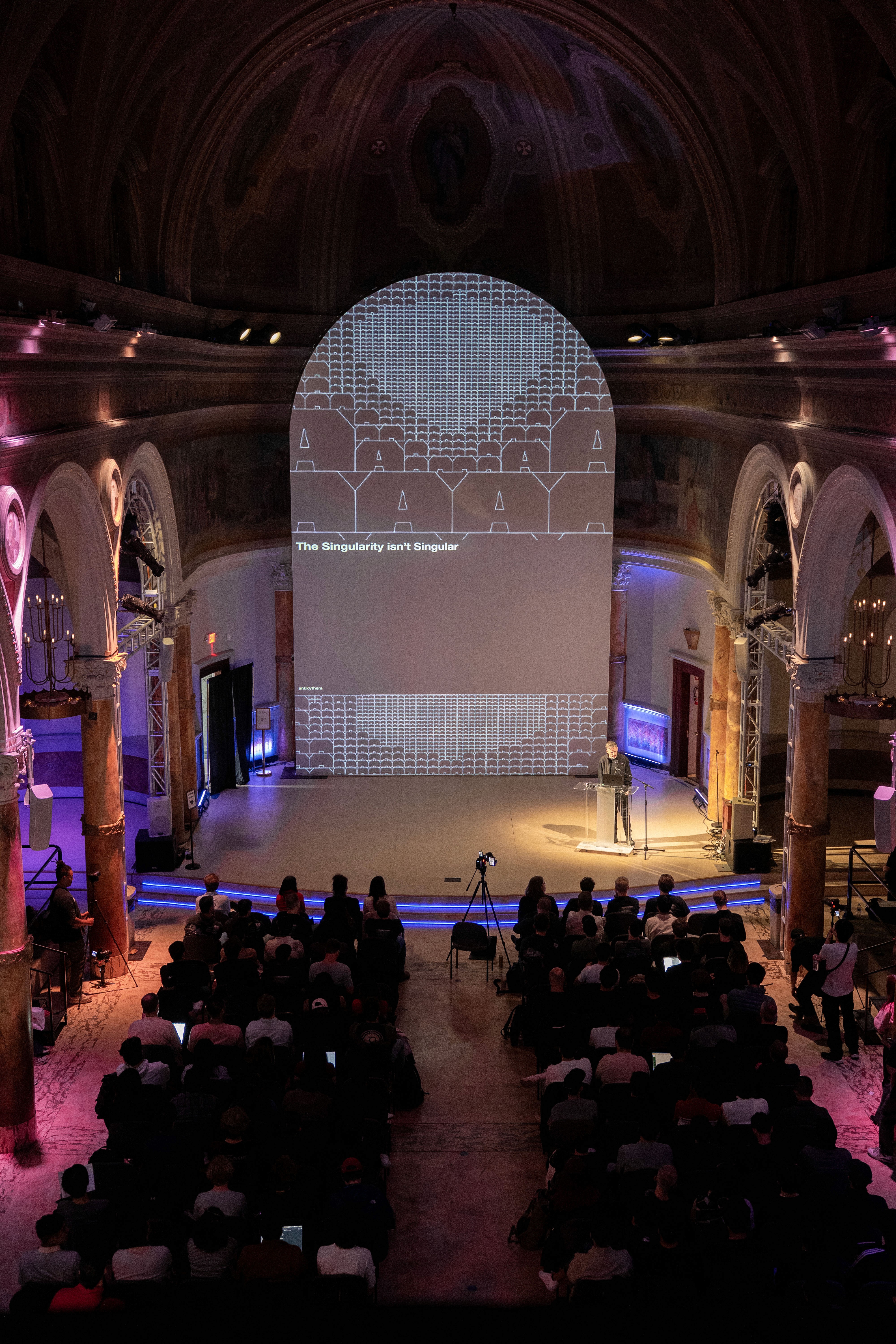
For contemporary evolutionary theory, to alter an ecological niche is not the privilege of any one species but an almost universal adaptive strategy. What then does it mean to speak of "artificial life,” "artificial intelligence,” "artificial bodies” (robotics) and even an "artificial ecology?” How do different cultural perspectives inform an understanding of comparative and convergent artificialization?

Miraikan

October

Tokyo

2025

Speculative Philosophy of Planetary Computation

Lecture

Benjamin Bratton

How does the acceleration of hybrid intelligences through planetary computation pose new challenges to fundamental philosophical questions? Planetary computation is an epistemological technology. It changes intelligence, poses new philosophical questions about reality, and shapes the future of complex life.

MIT Media Lab

October

Cambridge

2024

Planetary Sapience & Planetary Stupidity: a Bildungsroman for the Baby Noosphere

Lecture

Thomas Moynihan

The intertwined histories of scientific insight, planetary transformation, and technological folly are preludes to potential planetary sapience.The Earth emerges into self-awareness through human intelligence.

Central Saint Martins

July

London

2024

What is Intelligence?

Lecture

Blaise Agüera y Arcas

AI’s emergence is a natural consequence of evolution, suggesting a new theory of intelligence as such. Computation is fundamental to life and drives evolution.

Central Saint Martins

July

London

2024

57 Ideas & Questions about Cognitive Infrastructures

Lecture

Benjamin Bratton

As AI becomes both more general and more foundational, it shouldn’t be seen as a disembodied virtual brain. It is a real, material force. AI is embedding into the active, decision-making processes of real world systems. As AI becomes infrastructural, infrastructures become intelligent.

Central Saint Martins

July

London

2024

Recursive Worlds

Lecture

Sara Imari Walker

Life is an informational process that recursively constructs reality across time. Intelligence shapes matter, making Earth the universe’s most temporally vast object.

Central Saint Martins

July

London

2024

How to think unlike humans?

Lecture

Chen Qiufan

Speculative fiction offers a radical epistemological recalibration away from the anthropocentric biases constraining human cognition. Emblematic literary works open cognitive frameworks for meaningful interactions with diverse intelligences.

Central Saint Martins

July

London

2024

Futures of Multipolar Computation

Lecture

Benjamin Bratton

Societies and technologies always evolve in relation to one another. Today that means the design and deployment of hardware and software. The production of information has been a crucial factor, but the emergence of artificial intelligence, brings new models with increasing complexity and potential creativity. How can philosophy, design and science-fiction collaborate to conceive new futures? 

Design Innovation Institute

March

Shanghai

2024

For a General Theory of Simulations

Lecture

Benjamin Bratton

A general theory of simulations explores the roles of simulation in science, politics, identity, and cognition—shaping perception, action, and reality through recursion, reflexivity, and technological mediation.

USC

January

Los Angeles

2024

After Alignment

Lecture

Benjamin Bratton

What does it mean to ask machine intelligence to “align” to human wishes and self-image? Is this a useful tactic for design, or a dubious metaphysics that obfuscates how intelligence as a whole might evolve?

Central Saint Martins

July

London

2023

Comparative and Convergent Artificialization

Lecture

Benjamin Bratton

For contemporary evolutionary theory, to alter an ecological niche is not the privilege of any one species but an almost universal adaptive strategy. What then does it mean to speak of "artificial life,” "artificial intelligence,” "artificial bodies” (robotics) and even an "artificial ecology?” How do different cultural perspectives inform an understanding of comparative and convergent artificialization?

Miraikan

October

Tokyo

2025

Speculative Philosophy of Planetary Computation

Lecture

Benjamin Bratton

How does the acceleration of hybrid intelligences through planetary computation pose new challenges to fundamental philosophical questions? Planetary computation is an epistemological technology. It changes intelligence, poses new philosophical questions about reality, and shapes the future of complex life.

MIT Media Lab

October

Cambridge

2024

Planetary Sapience & Planetary Stupidity: a Bildungsroman for the Baby Noosphere

Lecture

Thomas Moynihan

The intertwined histories of scientific insight, planetary transformation, and technological folly are preludes to potential planetary sapience.The Earth emerges into self-awareness through human intelligence.

Central Saint Martins

July

London

2024

What is Intelligence?

Lecture

Blaise Agüera y Arcas

AI’s emergence is a natural consequence of evolution, suggesting a new theory of intelligence as such. Computation is fundamental to life and drives evolution.

Central Saint Martins

July

London

2024

57 Ideas & Questions about Cognitive Infrastructures

Lecture

Benjamin Bratton

As AI becomes both more general and more foundational, it shouldn’t be seen as a disembodied virtual brain. It is a real, material force. AI is embedding into the active, decision-making processes of real world systems. As AI becomes infrastructural, infrastructures become intelligent.

Central Saint Martins

July

London

2024

Recursive Worlds

Lecture

Sara Imari Walker

Life is an informational process that recursively constructs reality across time. Intelligence shapes matter, making Earth the universe’s most temporally vast object.

Central Saint Martins

July

London

2024

How to think unlike humans?

Lecture

Chen Qiufan

Speculative fiction offers a radical epistemological recalibration away from the anthropocentric biases constraining human cognition. Emblematic literary works open cognitive frameworks for meaningful interactions with diverse intelligences.

Central Saint Martins

July

London

2024

Futures of Multipolar Computation

Lecture

Benjamin Bratton

Societies and technologies always evolve in relation to one another. Today that means the design and deployment of hardware and software. The production of information has been a crucial factor, but the emergence of artificial intelligence, brings new models with increasing complexity and potential creativity. How can philosophy, design and science-fiction collaborate to conceive new futures? 

Design Innovation Institute

March

Shanghai

2024

For a General Theory of Simulations

Lecture

Benjamin Bratton

A general theory of simulations explores the roles of simulation in science, politics, identity, and cognition—shaping perception, action, and reality through recursion, reflexivity, and technological mediation.

USC

January

Los Angeles

2024

After Alignment

Lecture

Benjamin Bratton

What does it mean to ask machine intelligence to “align” to human wishes and self-image? Is this a useful tactic for design, or a dubious metaphysics that obfuscates how intelligence as a whole might evolve?

Central Saint Martins

July

London

2023